This page is reprinted from the June 2026 issue of the IIJ.news newsletter.
https://www.iij.ad.jp/news/iijnews/vol_194/detail_05.html
The AI era has arrived, and data centers must address the increase in power consumption. Amid the trend, it is not an exaggeration to say that measures to address the heat generated by equipment and efficiently cool it in these facilities have gone beyond being technical matters, and they are now management issues.
Below, the cooling systems used in data centers to address these issues are examined.
Cooling systems are management issues
In recent years, data centers have been shifting from air to liquid cooling systems. The background behind this shift is the rapid increase in the power consumption of the entire data center and the heat load per rack, which is attributable to the popularization of high-performance servers, mainly servers that include GPUs used for AI. It is easy to install conventional air-cooling systems and control initial investments in them, but they require the circulation of large volumes of air, and the power needed for cooling may be 30-40% of the total power consumption of the data center. This is why people have been working to reduce the cost of the electricity used by air-cooling systems. These efforts have included the installation of high-efficiency air conditioners, airflow control measures and direct outside-air cooling.
In contrast, liquid cooling systems directly cool heat sources such as CPUs and GPUs using water or other coolants with high thermal conductivity. In specific cases, it has been verified that it is possible to improve power usage effectiveness (PUE) and reduce the electricity used in cooling by double-digit percentages.
Controlling power consumption not only contributes to the reduction of operational expenses but also reduces environmental impact. Liquid cooling systems require a larger initial investment than air-cooling systems, so it is necessary to cooperate closely with server and rack providers in design and other activities. Taking efficient capacity and the future reduction of electricity expenses into account, however, liquid cooling systems are a reasonable choice over the medium and long term.
Amid the trend, data center cooling systems are being repositioned. Instead of just being an equipment issue, they are seen as a management issue as the goal becomes optimizing electricity expenses and environmental considerations.
What is direct liquid cooling?
It is possible to further classify liquid cooling systems, and direct liquid cooling (“DLC”) systems in particular are attracting attention. DLC systems use liquids to cool heat sources such as CPUs and GPUs.
A key feature of DLC systems is their ability to efficiently cool specific high-heat areas rather than cool entire spaces. Because of this, DLC systems are used in servers that are configured to generate a lot of heat, on the level of 100 kW per rack. It was difficult to adequately cool these servers using air-cooling systems. DLC systems make it possible for data centers to accommodate AI and a next-generation computing platform.
DLC systems include primary-side equipment distributed throughout the data center and secondary-side equipment located around the server racks. A chiller, dry cooler or other form of heat-exchanging equipment is used to cool a coolant before it is supplied via pipes to an area near a server room, where heat is exchanged between the primary and secondary sides of the system within the coolant distribution unit (CDU). After that, the secondary-side coolant is supplied to the cold plates installed in the individual servers via the manifolds in the server racks. This is a closed-loop system in which the coolant absorbs heat at the cold plate and then returns to the heat-exchanging equipment along a return path. (Figure 1)
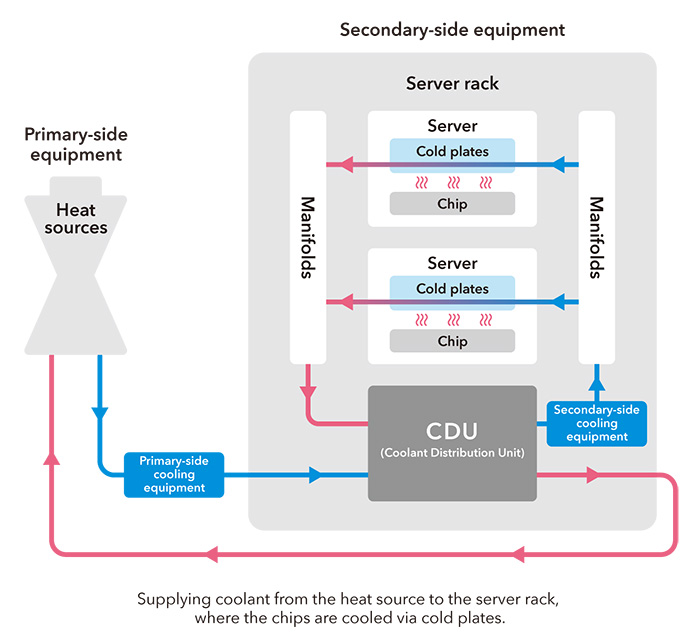
Figure 1 DLC System Diagram
A CDU, a core liquid cooling mechanism, controls the temperatures and flow rates of coolants and handles the exchange of heat between the primary and secondary sides of the system. There are two ways that CDUs can be installed: in-row or in-rack. In-row CDUs are compatible with large-capacity systems ranging between 500 and 2000 kW and are suitable for controlling at the row level, and in-rack CDUs are suitable when detailed control at the rack level is desired. In recent years, products featuring an increased number of redundant pumps, piping and filters inside CDUs, which make it possible to replace parts without stopping operations, have been launched, addressing high availability required in data center applications.
Inside server racks, manifolds distribute coolant to the individual servers. It is necessary to have a certain amount of vertical space to install manifolds, and conventional racks may be too small. Often, racks are extended or dedicated frames are attached to them. Universal quick disconnects (UQDs) complying with the standard established by the Open Compute Project (OCP) are used for connections within the systems. The quick attachment feature and the water leakage prevention mechanism streamline maintenance and increase durability.
A propylene glycol 25% aqueous solution (PG25), which presents a low risk of corrosion, is often used in the loop on the secondary side of the CDU. Purified water may also be used. On the primary side, water that is roughly equivalent to tap water is often used, and it needs to be managed in compliance with the water quality requirements of the CDUs. Water quality is often maintained in accordance with the guidelines in the ASHRAE Handbook, and corrosion inhibitor are added and other water quality improvement measures are taken as necessary.
Water pipes in server rooms can be suspended from the ceiling (overhead piping) or installed in a raised floor (underfloor piping). Underfloor piping is often used in Japan to mitigate leak risks, but some data centers use overhead piping. Regardless, systems must be designed to balance cost, constructability, maintainability, risks and other factors. (Figure 2)
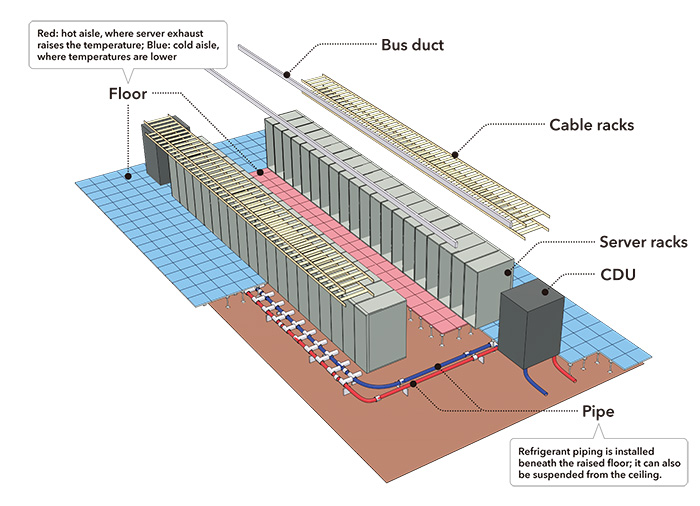
Figure 2 Coolant pipes inside a server room
Points to consider when installing DLC systems
When installing a DLC system, it should be noted that it must be used in combination with an air-cooling system. It is necessary to have a hybrid system that includes an air-cooling system for memory, power supply components, network switches and other components that cannot be cooled using the cold plates in DLC systems. Generally, it is recommended that approximately 70% of the total cooling capacity be provided by liquid cooling systems and 30% by air-cooling systems, but, in practice, designs are tailored to the configuration of the specific equipment. Data center providers do not always have facilities that can accommodate every custom design, so it is important to estimate the air-cooling system capacity that should be secured. Recently, servers that cool memory and other components with liquid have begun to be launched, and the fanless server trend is growing, but right now hybrid air and liquid cooling systems are prerequisite.
Problems with DLC systems
DLC technologies have been used in the supercomputer industry for many years. With their adaptation to data centers in recent years, there are still many unsolved problems.
For example, looking at pipe redundancy, if you install a looped pipe system in an N+1 configuration, it is necessary to install at least four pipes. Naturally, this impacts both cost and installation space, so care is necessary in the design stage. At the same time, it is necessary to consider equipment redundancy as well, not just piping, as CDUs typically have only one inlet port and one outlet port. Additionally, if there is a coolant leak in a server room, it is necessary to respond quickly and appropriately, without interrupting operations. There are many things to worry about with these systems.
The phase 3 building on the Shiroi Data Center Campus has a liquid cooling-ready design that ensures there is space for the installation of dedicated heat exchangers and piping with a view toward the installation of DLC systems. By preparing for the future installation of high-heat-generating servers beginning in the design phase, the building is flexible, expandable and unbound by conventional thinking about data centers.
Recently, this type of building has been called an "AI factory" overseas, not a data center. It is important to not be bound by conventional thinking based on standard designs or ways of operating.
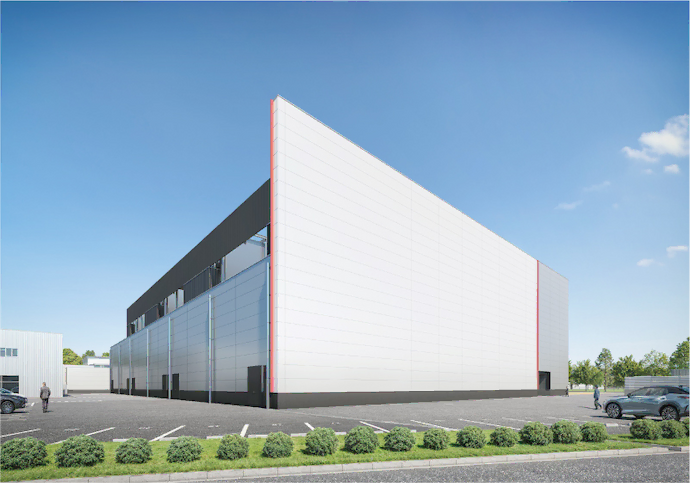
Conceptual render of the phase 3 building on the Shiroi Data Center Campus, which is scheduled to start operating in FY2026.